Refining the path from transcript to report
Arc gives the evidence behind a report its own space and brings the summary and full write-up together for review.
Work done October 19–30, 2026 · Last edited October 30, 2026
On this page
Arc’s path from transcript to report is taking shape. For speech-language pathologists (SLPs), examining the findings is a distinct part of that process: the measures, interpretations, and examples form the basis of the written account. Arc now gives that work its own space, with Transcript, Evidence, and Report as the three main tabs.
Sample details remain close at hand, opening from the sample’s name. They no longer occupy a main tab, keeping the focus on the transcript, its evidence, and the report.
Examining the evidence together
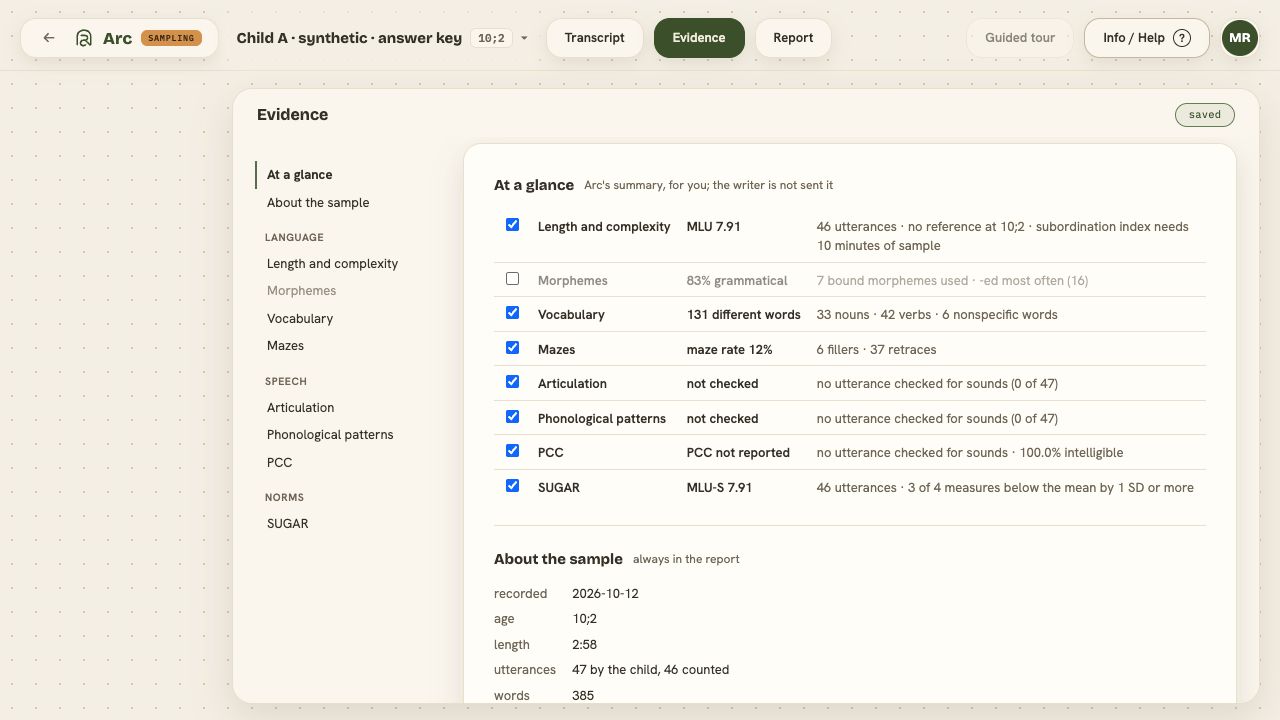
Evidence was previously inside the Report room, with each topic on a separate view. It now brings the findings together on one page, so the components of the report can be examined as a whole before moving into the write-up.
An At a glance overview shows the main figures across language and speech, alongside which topics are selected for the report. It also shows where a measure is not reported or a reference does not apply. The detailed tables, interpretations, and examples follow below, with a contents list linking to each topic.
Reviewing the written account
The report now shows its Summary and Full report together in one document. The Summary is written for an evaluation’s expressive-language section; the Full report provides the language-sample account. Showing both together keeps the brief account alongside the detail it draws on during review and editing.