Writing reports and managing samples
Arc now generates editable report drafts from reviewed findings, and adds Google sign-in, accounts, sample deletion dates, and a download of the complete sample.
Work done October 12–17, 2026 · Last edited October 19, 2026
This week’s reporting work turns the findings from a speech and language sample into a written draft. The measures, interpretations, and examples selected for the report now form the basis of a short and a full write-up that can be reviewed and edited. Arc also now has accounts with Google sign-in, and each sample can be given a deletion date and downloaded as a single file.
Report room
The Report room replaces the Review screen described in the previous entry. Its Evidence tab brings together findings on topics such as language complexity, vocabulary, articulation, and phonological patterns. Each topic shows its measures, reference comparisons and their sources, editable interpretations, and suggested examples from the sample.
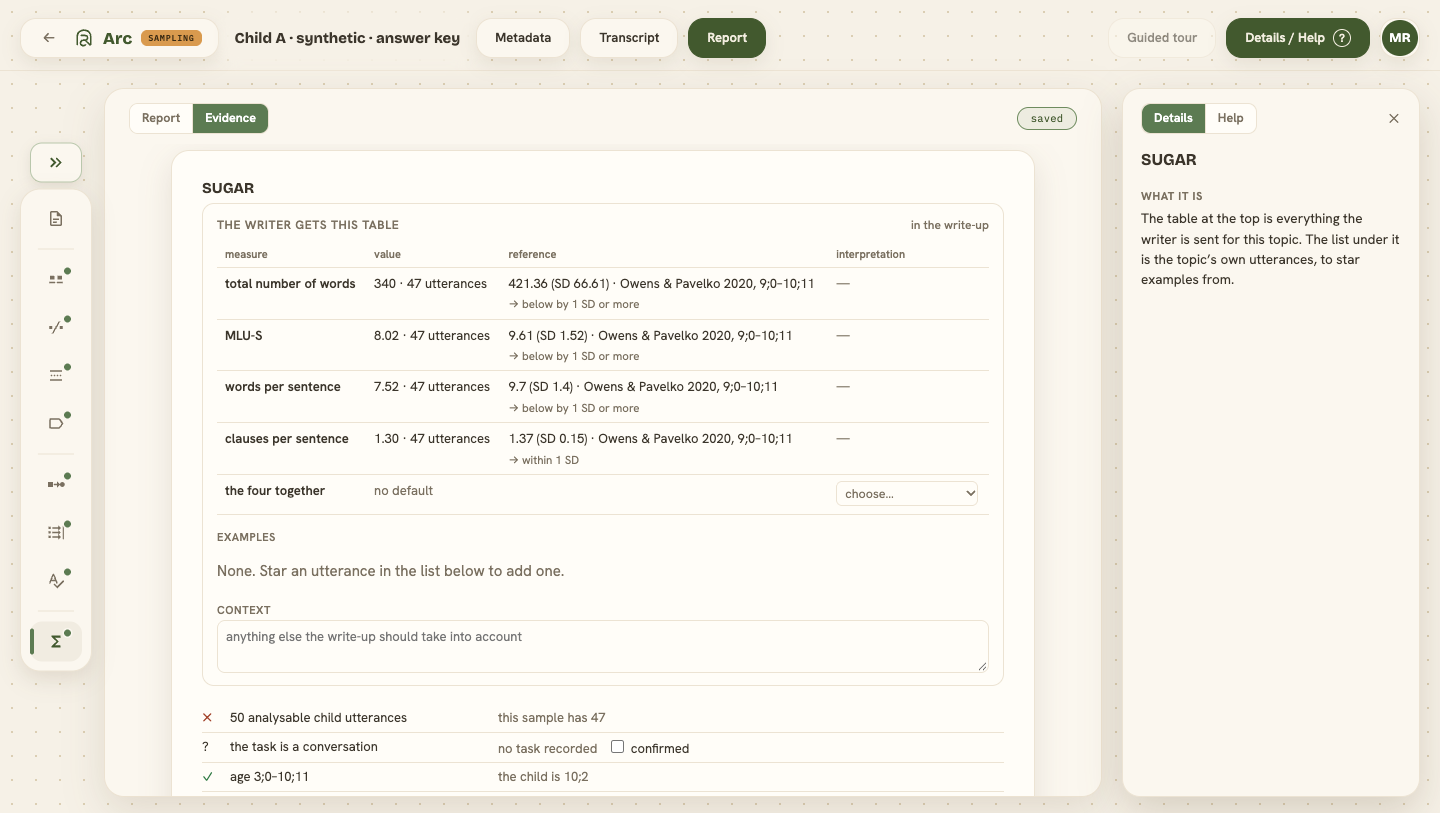
The reference comparisons come from published tables: MLU in morphemes by age (Rice et al., 2010), consonant acquisition ages (Crowe & McLeod, 2020), PCC severity bands (Shriberg & Kwiatkowski, 1982), and the SUGAR cut score for ages 3;0–7;11 (Pavelko & Owens, 2019).
For example, an articulation finding pairs a consonant’s production in the sample with its expected acquisition age and an editable interpretation. Where a comparison does not fit the child or the sample, it is marked as not comparable, with the reason recorded. The child’s engagement during the sample, and whether the sample was typical, are recorded with the sample’s details and carried into the report.
The Report tab generates a short and a full write-up from the findings, interpretations, and examples selected in the Evidence tab, which shows exactly what each write-up was generated from. Both versions are editable and can be copied or printed, including to PDF. Impressions and recommendations have their own section, which is never generated and is kept when a write-up is regenerated.
Accounts and sign-in
Arc now has accounts, with Google sign-in for invited addresses. Each account has its own sample library and profile, and the library is there wherever the account signs in.
Deletion dates and download
Each sample can have a deletion date, shown on its card in the sample library. During the two weeks before that date, the card shows how many days are left. After that date, the recording, transcript, and report are deleted.
A complete sample downloads as one ZIP file: the original recording, the transcript in CHAT format, a copy of the sample in Arc’s own format, and the short and full write-ups when available.