Anna, 10: a fourth-grader with developmental language disorder
Anna’s transcript was written to resemble a ten-year-old with developmental language disorder. This example follows her narrative language sample from the transcript to the report, with the evidence and reasoning shown beside each section. Her sample shows a pattern reported in school-age children with language impairment: the story holds together while the tense and agreement marking does not.
The language sampling task
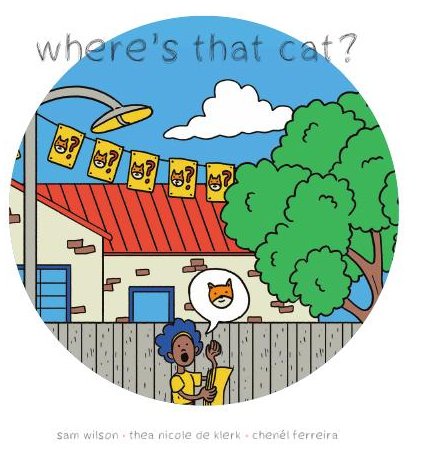
For Anna’s triennial re-evaluation, her SLP collected a narrative language sample alongside the standardized measures. Anna looked through the wordless picture book Where’s That Cat? and then told its story in her own words.

The transcript
(Grey, in parentheses): mazes, which are repetitions, revisions, and fillers. [Brackets]: the expected form after an error.
Pages 6–7
Pages 8–9
Pages 10–11
Pages 12–13
Pages 14–16
Pages 17–19
Pages 20–22
Pages 23–25
Pages 26–27
Pages 28–29
Pages 30–32
The transcript analysis
The analysis works through the five areas of language ASHA identifies: phonology, semantics, morphology, syntax, and pragmatics, which includes discourse. Findings are compared against Common Core language standards, developmental research, and research on clinical profiles. No normative comparisons were used.
The thinking
The write-up
Orientation Anna’s write-up will be read by her family and her teachers as well as the evaluation team. So before any finding, the opening gives them the ground: how old Anna was and what grade she was in when the sample was taken, why it was taken, what she was asked to do, and which parts of her language the write-up looks at. Those parts are described as vocabulary, grammar, sentences, and storytelling, with the clinical term alongside each heading, so that every reader starts from the same understanding of what is being described.
Language sampling task and purpose of the report
Anna is a ten-year-old fourth-grade student. A narrative language sample was collected to examine how she uses spoken language to describe events and communicate a connected story. She was asked to tell the story depicted in the wordless picture book Where’s That Cat? This report describes the vocabulary, grammatical forms, and sentence structures she used, together with her organization of the story and the information she provided to help the listener follow it.
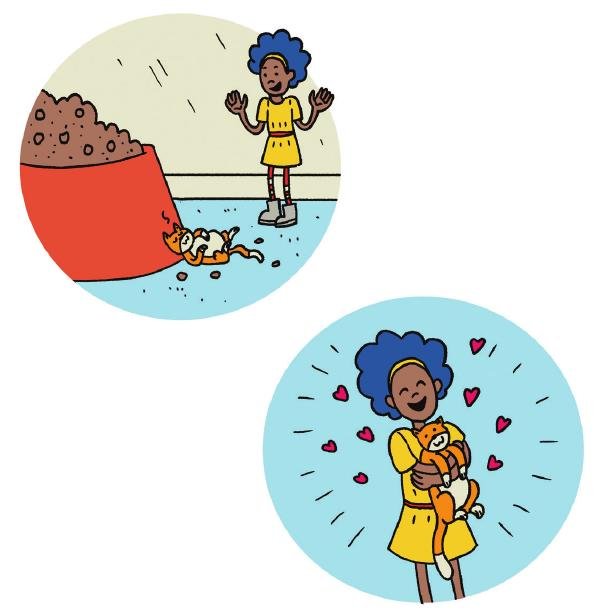
Book context Readers of the write-up may not know Where’s That Cat?. A short summary of the plot tells them what Anna was retelling, so that her quoted sentences can be understood in context.
Story orientation
The story begins in a house full of inventions. A girl is repairing a toy car while her father works nearby, and the family’s cat watches from a shelf. When the cat disappears, the girl searches for him, calls for him, and puts up missing-cat posters. A trail of spilled cat food leads the girl to her father’s workshop and a shrinking machine. After becoming tiny herself, the girl encounters butterflies and caterpillars that now tower over her. She eventually finds the cat, who has also been shrunk, beside his food bowl. The girl uses the toy car she was repairing to carry herself and the cat back to her father.
Completeness Speech sounds are one of the areas a language sample can speak to, but they were not examined for Anna. The write-up names the area and says it was not assessed, so that leaving it out of the analysis reads as intentional.
Speech sounds (phonology)
No concerns were reported about Anna’s speech sound production. Speech sounds were not assessed during this task.
Evidence Anna names objects and actions specifically: screwdriver, climbed, hugged. She describes the girl’s changed size with “bigger than her” and “huge”. She first calls the magnifying glass “the looking thing,” then revises it to “the magnifying glass” without a prompt from the examiner.
Reference Fourth-grade Common Core L.4.3a and L.4.6 call for precise wording and vocabulary that expresses particular actions, emotions, and states.
Interpretation “The looking thing” followed by “the magnifying glass” could be read as a word-finding difficulty or as a successful self-revision. The write-up reports both productions together, because the label she reached and the phrase she reached it through are the same piece of evidence about how she uses words.
Vocabulary and meaning (semantics)
Anna’s word choices conveyed the girl’s actions, intentions, and emotional responses during the search. She used action words such as “climbed,” “screamed,” and “hugged,” and expressed the girl’s motivation through “she really wanted to find him.” Her descriptions also conveyed the experience of being tiny: the screws were “bigger than her,” and the cat’s bowl was “huge.” Anna used specific object names, including “screwdriver” and “caterpillar.” At times, she arrived at a specific label after an initial description, replacing “the looking thing” with “the magnifying glass” without the examiner supplying the word.
Evidence Anna marks past tense in looked, asked, went, and climbed. Alongside these she produces “she start to make lots of posters,” “a butterfly come at her,” and “she try to run away from it.” She omits the auxiliary in “she waving at him from the car” and uses was with a plural subject in “the screws was bigger than her.”
Reference Common Core places regular and irregular past tense, simple tenses, and subject–verb agreement in third grade, and progressive forms such as was walking in fourth.
Interpretation The write-up reports one finding, inconsistent grammatical marking, rather than three separate ones, because the examples share the pattern: tense, auxiliary, and agreement each succeed in some productions and not in others. “Got shrinked” shows the pattern inside one verb: got carries the past tense, and shrinked is an overregularized participle.
Grammatical forms (morphology)
Anna generally used past-tense verbs to recount the girl’s search, including “looked,” “asked,” and “went.” Past-tense marking was inconsistent, however. When describing the girl making missing-cat posters, Anna said “she start to make lots of posters.” Later, after the girl had become tiny, Anna described the butterfly encounter with “a butterfly come at her” and “she try to run away from it.”
Other grammatical forms also varied. When the girl returned to her father, Anna said “she waving at him from the car,” leaving out the helping verb “was.” Describing the girl’s tiny size, she said “the screws was bigger than her,” using the singular verb “was” with the plural subject “screws.”
Evidence Anna coordinates clauses in “she asked the man and he didn’t see him.” She subordinates with because in “she was scared because it was so big” and with when in “when she got close the thing turned on and got her.” “The room where the man was” is a relative clause, and “to find him” in “she really wanted to find him” is an infinitive.
Reference Common Core places compound and complex sentences and their conjunctions in third grade, and relative constructions in fourth. Hamilton and colleagues found grammatical complexity increasing between ages 9 and 12 in wordless-picture-book narratives.
Interpretation Sentence construction and grammatical marking are reported as separate findings, because how Anna builds a sentence and how she marks the verbs in it can succeed or fail independently: “a butterfly come at her” is a well-formed sentence with a missing tense marker.
Sentence construction (syntax)
Anna used both compound and complex sentences. When describing the girl asking about the missing cat, she joined clauses with “and”: “she asked the man and he didn’t see him.” Her complex sentences included a subordinate clause introduced by “because” when explaining the girl’s fear of the butterfly: “she was scared because it was so big.” When describing the shrinking machine, she used a clause introduced by “when”: “when she got close the thing turned on and got her.”
Anna also used a relative clause to identify the room reached by the food trail: “it went into the room where the man was.” The girl’s search goal appeared in an infinitive construction, “to find him,” in “she really wanted to find him.”
Evidence Anna tells the search, the shrinking, the garden, the discovery, and the return in order, and explains some of the girl’s reactions on her own, including “she was scared because it was so big.” At the discovery she describes finding the cat and the reunion but does not say the cat had been shrunk; when the examiner asks why nobody could find him, she answers “I think the machine got him too” and “so nobody could see him because he was too little.” She refers to the cat as “he” before naming him as “the cat,” and at the reunion says “she was happy to see her.”
Reference Fourth-grade Common Core SL.4.4 calls for organized storytelling with relevant details supporting the main ideas.
Interpretation Anna’s telling is reported as organized because the events come in order and some reactions are explained without a prompt. The cat’s shrinking is reported as a connection she left implicit rather than one she missed: the pictures were in front of both of them, and she supplied the explanation as soon as she was asked. The pronoun change at the reunion is reported as a matter of consistency, since the surrounding passage makes clear who is meant.
Storytelling (pragmatics and discourse)
Anna organized her account around the girl’s search for the missing cat. She described the search attempts, the shrinking, the encounters in the garden, and the discovery and return in sequence. She also explained some motivations and reactions, including the girl’s wish to find the cat and her sadness when nobody had found him.
When describing the discovery, Anna said that the cat was beside the bowl and described the reunion, but did not explain that the cat had also been shrunk. After the examiner asked why nobody could find him, she answered, “I think the machine got him too” and “so nobody could see him because he was too little.” Anna supplied the explanation connecting the disappearance with the machine in response to a question, having left that connection implicit during her story.
Some character references were less explicit. Anna initially referred to the cat as “he” before introducing him as “the cat.” During the reunion, she said “she was happy to see her,” changing the pronoun previously used for the cat. The discovery passage helped identify the intended participants, although the pronoun change made the reference less consistent.
Synthesis The conclusion separates strengths from challenges so that each can be seen on its own: Anna’s specific vocabulary, varied sentence construction, and organized telling on one side, and her inconsistent grammatical marking and the connection she supplied only when asked on the other. Each point repeats a production already shown in its section.
Profile comparison Reilly and colleagues found that morphological weaknesses continued in school-age children identified with specific language impairment, through ages 10 to 12. Anna’s tense, auxiliary, and agreement difficulties resemble that pattern, which is why the conclusion cites it.
Conclusion
Strengths. Anna told an organized story, following the search for the cat through the discovery and return home. She used complex sentences to connect ideas, explaining the girl’s fear of the butterfly with “she was scared because it was so big.” Her vocabulary conveyed specific objects and actions, and she independently made some wording more precise—for example, replacing “the looking thing” with “the magnifying glass.”
Challenges. Grammatical marking was inconsistent despite successful past-tense forms elsewhere. Examples included “she try to run away” during the butterfly encounter and “she waving at him from the car” when the girl returned to her father. This pattern resembles grammatical weaknesses reported in school-age children with language impairment. Reilly et al. Anna also left an important story connection implicit: she described finding the cat but explained that the machine had shrunk him only after the examiner asked why nobody could find him.
Sources
- American Speech-Language-Hearing Association. Spoken language disorders: Speech and language evaluation.
- Wilson, S., de Klerk, T. N., & Ferreira, C. (2020). Where’s that cat? Book Dash. Book and images. CC BY 4.0. Cover cropped to its front.
- Common Core State Standards Initiative. English Language Arts Standards: Grade 3 Language, Grade 4 Language, and Grade 4 Speaking and Listening.
- Hamilton, L. G., O’Halloran, I., & Cutting, N. (2021). Individual differences in narrative production in late childhood: Associations with age and fiction reading experience. First Language, 41(2), 179–199. https://doi.org/10.1177/0142723720946553.
- Reilly, J., Losh, M., Bellugi, U., & Wulfeck, B. (2004). “Frog, where are you?” Narratives in children with specific language impairment, early focal brain injury, and Williams syndrome. Brain and Language, 88(2), 229–247. https://doi.org/10.1016/S0093-934X(03)00101-9.